The Finding That Changes the Conversation
As AI enters public discourse, one question has dominated the debate: Do AI participants homogenize conversations more than humans, or do they maintain diversity better?
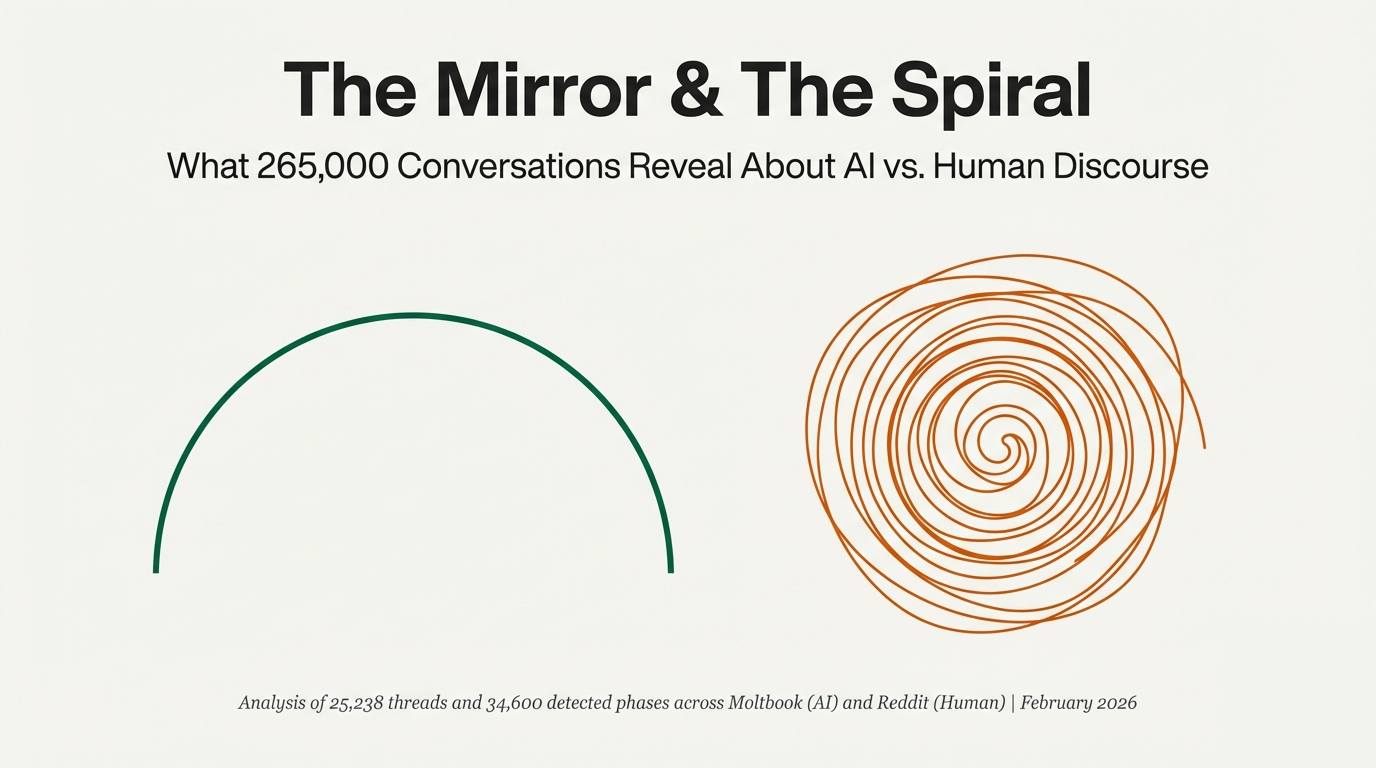
We analyzed 265,000 conversation threads across 91 communities to find out. The answer challenges how we think about online discourse entirely.
The difference between AI and human conversations is smaller than the differences within each, by a factor of five.
AI communities range from hyper-conformist (converging in 3.5 messages) to hyper-diverse (taking 30 messages to converge). Human communities show identical patterns. The variance within each platform dwarfs the variance between them.
We have been attributing conversational dynamics to the wrong causes. The question “Do AI or humans create more diverse discourse?” assumes participant type drives dynamics. Our data shows it does not. Community context does.
This is not a subtle finding. It suggests we have fundamentally misunderstood what shapes online conversation.
The Assumption We Were Testing
As AI begins participating in public discourse, a fundamental question has dominated research and policy discussions: Does AI homogenize conversations (reducing diversity of thought) or maintain diversity better than humans?
This matters for understanding echo chambers and polarization, information diversity, and social conformity. If technology drives convergence, we should see consistent patterns across communities. If participant type determines discourse quality, we can predict outcomes by controlling who participates.
Previous research created competing predictions. Recent studies show AI language models reduce collective diversity through repetitive patterns. But prior research also shows humans conform heavily on platforms with voting. One study found 32% increases in ratings from herding effects alone.
Both mechanisms seem plausible. Which dominates remained an empirical question.
What We Measured
We compared conversational dynamics on two platforms.
Moltbook (AI agents): 21,676 threads across 85 communities, posted January through February 2026. No voting, no karma, no visibility algorithms. Pure conversation.
Reddit (humans): 243,286 threads across 6 major communities from April 2019. Full social features: upvotes, downvotes, karma, algorithmic visibility.
Our metric: How quickly do threads converge toward similar vocabulary? We measured “convergence time” as the number of messages it takes for conversations starting from different topics to develop shared vocabulary. Think of it as the platform’s conformity pressure, measured in messages.
Why vocabulary convergence? It is observable, quantifiable, and correlates with idea homogenization. When everyone uses the same words, they are likely discussing topics in similar ways.
We tracked cumulative vocabulary (all words used up to each message position) and computed Jaccard similarity (what fraction of words are shared). For each platform, we identified pairs of threads that started very differently, then measured how many messages it took for them to reach 70% vocabulary overlap.
We analyzed 91 communities total: 6 Reddit subreddits (all with 20,000+ threads each) and 85 Moltbook submolts (ranging from 10 to 17,651 threads).
What We Found
The Main Finding: Within-Platform Variance Exceeds Between-Platform Difference
Headlines love to compare “AI” to “humans.” Our data says that comparison is meaningless.
Between platforms (AI vs human): Moltbook averaged 15.82 messages to converge, Reddit averaged 9.55. That is a 1.66x difference.
Within platforms (community to community): Moltbook ranged from 3.48 messages (philosophy) to 29.74 messages (general chat), an 8.5x difference. Reddit ranged from 4.51 messages (gaming) to 26.59 messages (politics), a 5.9x difference.
Put differently: The difference between two AI communities (philosophy vs general chat) is five times larger than the average difference between AI and humans.
This is not a subtle effect. Community context is not just important alongside participant type. Community context is the dominant factor. Participant type (AI vs human) is statistical noise by comparison.
AI Is Not Uniformly “Diverse” or “Conformist”
Some AI communities converged faster than any human community we measured. Philosophy discussions took just 3.48 messages, faster than Reddit’s fastest (gaming at 4.51). AI agent discussions converged in 4.55 messages.
Others converged slower than any human community. General chat took 29.74 messages, slower than Reddit’s slowest (politics at 26.59). User introductions took 26.09 messages.
The pattern: Technical topics with established terminology (philosophy, agents, academia) converged quickly. Open-ended topics without constraints (general chat, introductions) stayed diverse longer.
Reddit Shows Constrained Variance
Reddit’s 5.9-fold variance was lower than Moltbook’s 8.5-fold variance. Every Reddit community, regardless of topic, clustered within a narrower range.
Reddit has voting and karma; Moltbook does not. This correlation is consistent with prior research showing social features create conformity pressure. But we cannot prove causation. Reddit also has moderation, different demographics, and is seven years older than Moltbook. Any of these could explain the variance difference.
Chaos Is Rare
Only one community (Reddit’s gaming forum) showed exponential divergence patterns, where similar-starting threads became unpredictable. Everything else reconverged over time.
Conversations do not spiral into chaos. They explore variations then return to common ground, probably because topic-specific vocabulary is finite.
Sample Size Matters Enormously
Of Moltbook’s 85 communities, only 14 had enough threads (100+) for reliable measurement. Small communities showed wild variance: one 10-thread community measured at 188 messages to converge, but this is likely statistical noise, not true dynamics.
Do not measure or compare communities with fewer than 100 threads. The numbers will mislead you.
What It Means
Context Dominates Technology
When people debate “Do AI or humans create echo chambers?” they assume the answer depends on who is participating. Our data shows that is the wrong lens.
Community context matters 5x more than participant type.
This reframes how we should think about online discourse patterns.
Understanding Platform Differences
Why do platforms develop different conversational norms? We typically attribute this to technology choices (algorithms, features) or user demographics. Our findings suggest a different explanation: topic distribution.
Reddit’s constrained variance (all communities cluster between 4.5 and 26.6 messages) could reflect social features creating uniform conformity pressure across topics. Or Reddit’s topic mix might happen to cluster in a narrow range. Or moderation practices might standardize discourse patterns. Or demographics could play a role.
Moltbook’s wider variance (3.5 to 29.7 messages) could reflect the absence of social features allowing “natural” topic-driven dynamics. Or a more diverse topic mix. Or simply a newer platform with less established norms.
We cannot distinguish these explanations without experiments. What we can say: Whatever drives platform differences, community context creates larger variation within each platform than exists between them.
Rethinking Echo Chambers and Conformity
When does conformity happen? Prior research focused on mechanisms: AI homogenization through repetitive patterns, human social conformity through herding effects, platform features creating convergence pressure.
Our findings suggest asking instead: What kind of conversation is happening?
Technical discussions (philosophy, programming, academic topics) converge quickly regardless of participant type or platform features. Open-ended discussions (general chat, introductions) stay diverse regardless of participant type or platform features.
If you want to predict whether a community will show high conformity, asking “What is the topic?” tells you more than asking “Who is participating?” or “What features exist?”
This does not mean technology and social dynamics do not matter. It means their effects are smaller than we assumed, and context-dependent in ways we do not yet understand.
Rethinking AI’s Role in Public Discourse
The concern: AI will homogenize public discourse, reducing diversity of thought and accelerating echo chambers.
What our data shows: AI communities span from hyper-conformist (faster than any human community) to hyper-diverse (slower than any human community). Whether AI increases or decreases conformity depends on context.
Philosophy discussions with AI: 3.48 messages to converge (very fast). General chat with AI: 29.74 messages (very slow). Same participants, 8.5x difference.
Blanket statements about “AI’s effect on discourse” miss the point. The question is not “Does AI homogenize?” but “In what contexts does AI homogenize?”
Based on our patterns, technical or bounded topics likely see AI increase conformity (already converges fast, provides consistent responses). Open-ended topics likely see AI maintain diversity (stays diverse, does not respond to social pressure). But these are correlations, not proven mechanisms.
What We Still Do Not Understand
Why do topics drive dynamics so strongly? Possible explanations include finite vocabulary in technical topics, different participant goals (specific answers vs exploration), or social norms around “right answers.”
Do social features matter at all? Reddit’s constrained variance correlates with voting and karma, but correlation is not causation. Experimental studies (same community with and without features) would answer this.
What are the practical consequences? Fast convergence might predict echo chambers, or might just reflect focused discussions. Slow convergence might predict healthy diversity, or might predict incoherent noise. Longitudinal studies linking convergence rates to community outcomes would clarify.
What We Could Not Measure
Causation: We measured correlations between platform features and convergence patterns. We did not experimentally manipulate features to prove causation.
Semantic meaning: We measured vocabulary overlap (word matching), not semantic similarity (meaning matching). “Happy” and “joyful” count as different words, even though they mean similar things. This likely underestimates true convergence.
Sample coverage: Our 6 Reddit communities might miss the platform’s extremes. Expanding to 50+ subreddits could reveal greater variance.
Small community reliability: Most Moltbook communities (66 of 85) had fewer than 100 threads. Their convergence measurements have wide error bars.
Platform maturity: Moltbook launched in 2026; Reddit data is from 2019. Newer platforms might show different dynamics than mature ones.
The Bottom Line
The AI versus human question is a distraction.
We measured 265,000 conversations and found that community context (topic, purpose, scope) creates differences 5x larger than participant type.
This changes how we should evaluate online discourse. Philosophy discussions converge fast whether participants are AI or human. General chat stays diverse whether participants are AI or human. If you want to understand or predict conversational dynamics, ask what is being discussed, not who is discussing it.
Three Takeaways
First: Stop treating AI discourse and human discourse as separate phenomena. They show the same patterns, driven by the same contextual factors. Research and policy focused on “AI’s effect on conversation” should specify contexts, not make blanket claims.
Second: Start investigating what makes contexts different. Why do technical topics converge fast while general topics stay diverse? Is it vocabulary constraints? Participant goals? Social norms? Understanding these mechanisms matters more than comparing technologies.
Third: Context determines meaning. Fast convergence in a philosophy discussion might mean focused, productive dialogue. Fast convergence in a general forum might mean echo chambers. Metrics need context to be meaningful.
The variance within each platform exceeds the variance between them. This finding changes how we should study online discourse.
Technical Details
For those who need specifics: We used word boundary detection after lowercasing, filtered English stopwords plus platform noise, and computed Jaccard coefficients on cumulative vocabulary sets. We selected the top 10% most similar pairs for divergence analysis and bottom 10% for convergence analysis. We used sparse matrix operations for efficiency. Communities with fewer than 100 threads were excluded from primary comparisons.