In gilded Troy, where Priam’s daughter dwelt,
fair Cassandra at Apollo’s altar knelt.
The god of prophecy, struck by desire,
offered his gift to win the maiden’s fire.
“Speak true of what shall be,” he promised her,
“See all futures, certain and secure.
But heed me well—” (for gods know mortal ways)
“You’ll need a plan to share what sight displays.
First, build consensus with the council old,
prepare your allies ere the truth be told.
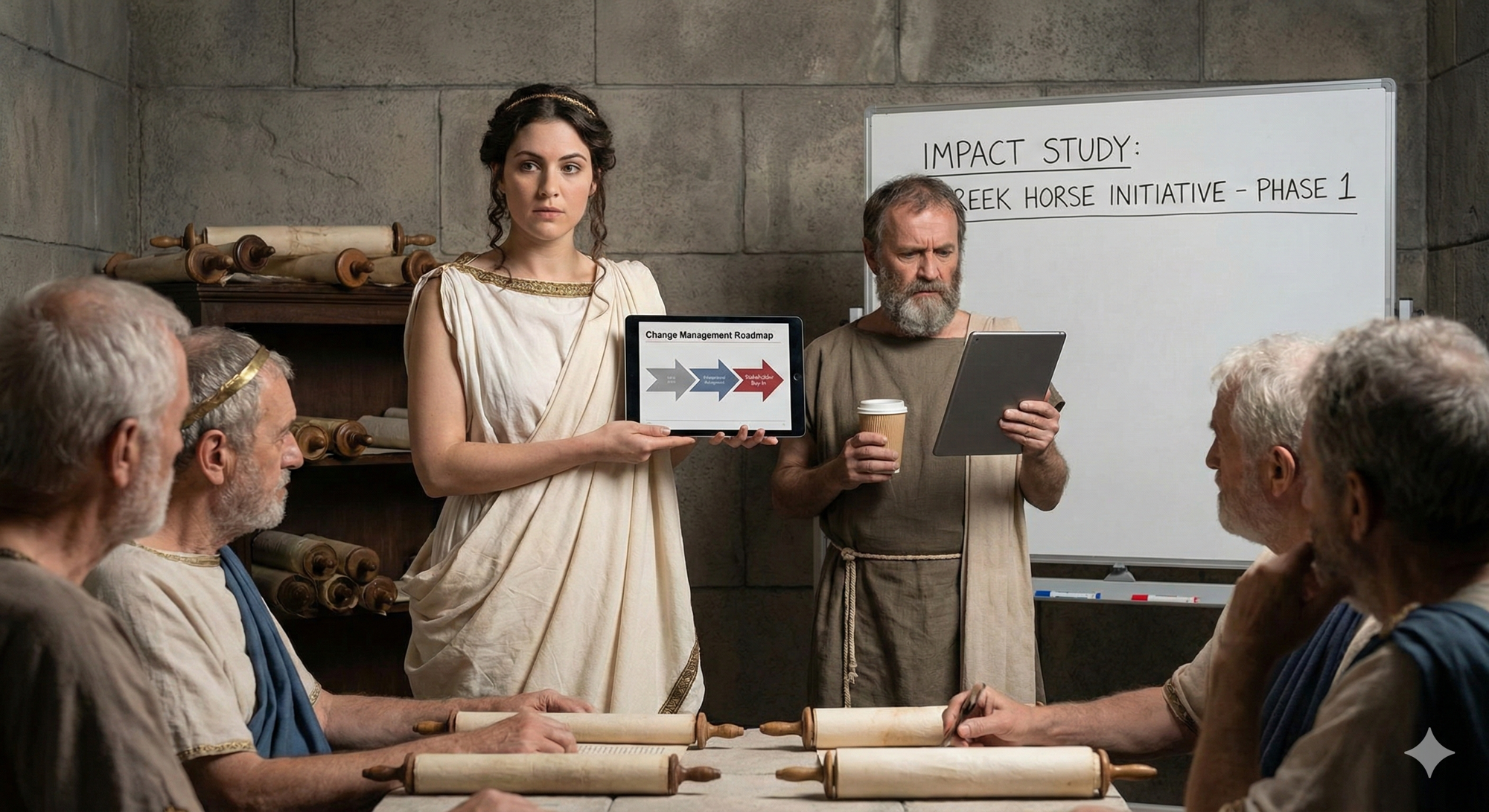
Create a roadmap, staged in careful parts,
with metrics, timelines, stakeholder buy-in charts.”
But Cassandra, eager for the sight alone,
dismissed such talk with an impatient tone.
“Just give the vision! That shall be enough—
Truth needs no introduction, politics, or fluff.”
Apollo shrugged—the gift was freely given,
though best practices were clearly written.
She saw the horse, the flames, the falling towers,
but rushed to tell Troy’s court within the hour.
“The city burns!” she cried. “Greeks hide in wood!”
The council blinked. They hadn’t understood
the context for her claims, nor trusted she
who’d skipped the Steering Committee.
King Priam sighed, “You’ve brought no impact study,
no phased approach, your presentation’s muddly.
Where are your sponsors? Where’s your executive brief?
We can’t accept such sudden, unsourced grief.”
And thus poor Cassandra, though her visions rang true,
had failed at the rollout—that much all knew.
The god had warned her: prophecy’s just half—
the other half is a communication graph.
So learn, you mortals, from this ancient case: transformation needs more than a database. Whether seeing futures or implementing change, you’ll need a change board, not just a vision strange.